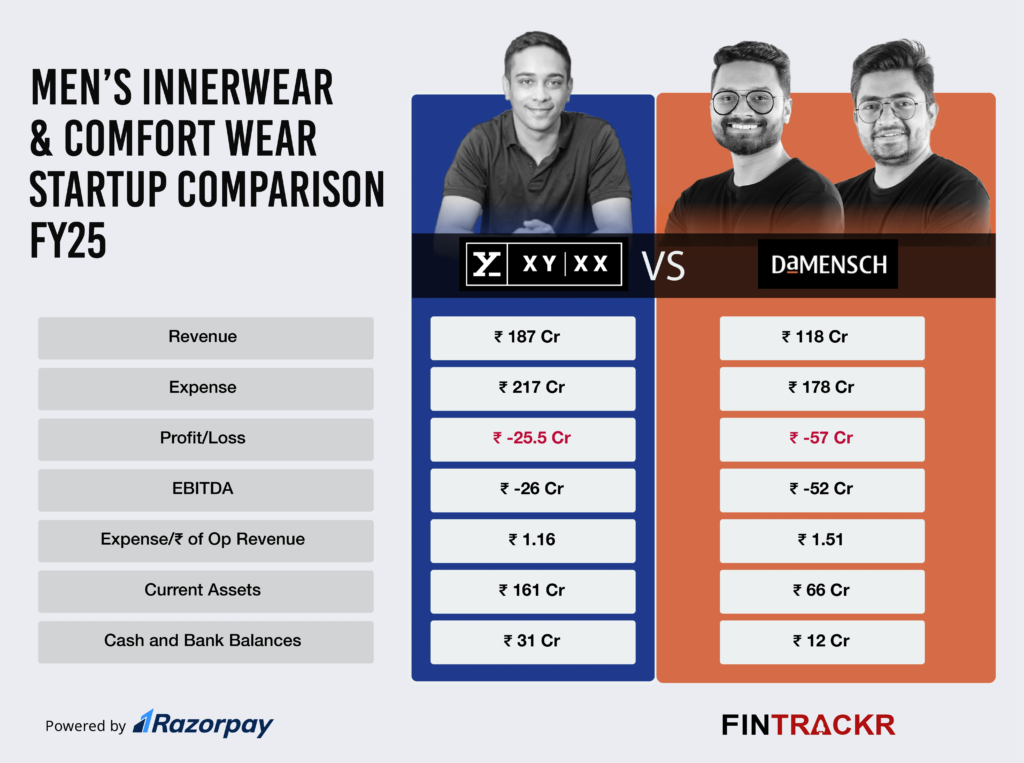
The men’s innerwear market in India is witnessing significant developments as D2C brands XYXX and DaMENSCH continue their expansion efforts in FY25. Despite achieving considerable growth in revenue, both companies are grappling with the challenge of profitability, underscoring the competitive and cost-intensive nature of the sector.
### Scaling Efforts and Financial Performance
XYXX has emerged as a frontrunner in the men’s innerwear segment, with its operating revenue surging by 46% to Rs 187 crore in FY25, up from Rs 128 crore in FY24. This growth has positioned XYXX ahead of DaMENSCH, which reported a 34% increase in revenue, reaching Rs 118 crore. The disparity in scale is evident, with XYXX generating 1.6 times the revenue of DaMENSCH.
The financial statements reveal distinct cost structures for the two companies. XYXX incurred higher raw material costs at Rs 99 crore, reflecting its larger scale, and invested Rs 50 crore in advertising, nearly double that of DaMENSCH’s Rs 27.5 crore. Conversely, DaMENSCH reported higher employee benefit expenses at Rs 29 crore compared to XYXX’s Rs 26 crore, while commission expenses for both companies remained in a similar range.
Despite their growth, both companies remain loss-making, with XYXX showing a sharper improvement by reducing its net loss by 28% to Rs 25.5 crore. DaMENSCH saw a marginal decline in losses, reporting Rs 57 crore in FY25.
### Competitive Landscape and Market Dynamics
The men’s innerwear market is becoming increasingly competitive as established players and new entrants vie for consumer attention. While XYXX and DaMENSCH have scaled significantly, Bummer operates on a smaller scale, reporting a 22% increase in revenue to Rs 11 crore in FY25. However, Bummer’s losses doubled to Rs 4 crore, highlighting the difficulties faced by smaller players in achieving profitability.
The competition is further intensified by incumbents like Page Industries, which owns Jockey. These established brands are refining their strategies, focusing on a broader portfolio and maintaining margins by minimizing discounts. This strategic positioning poses a significant challenge to startups, which must balance aggressive growth with sustainable unit economics.
### Implications for India’s Startup Ecosystem
The journey of XYXX and DaMENSCH reflects broader trends in India’s startup ecosystem, where achieving scale often comes at the expense of immediate profitability. The emphasis on brand-led growth and product innovation is crucial, but startups must also navigate the complexities of cost management and market competition.
The path to profitability is fraught with challenges, as startups must moderate growth to tighten unit economics and preserve capital. The current landscape suggests a potential shakeout, where only those who can effectively balance growth and profitability will thrive.
As the sector evolves, these companies may need to refine their strategies to stay competitive. The focus will likely shift towards optimizing operations and exploring new market segments to sustain growth without compromising financial health. The coming years will be critical for these startups as they strive to establish themselves firmly in India’s burgeoning D2C market.